

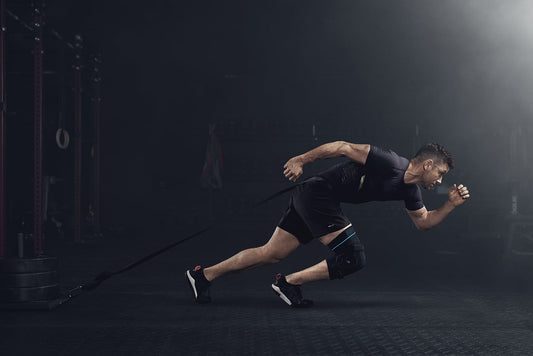
Knee pain and joint instability are common reasons people look for bracing solutions, but many shoppers struggle to understand which type of product they actually need. One of the most frequent points of confusion is the difference between a knee stabilizer vs a knee support. These terms are often used interchangeably online and in stores, even though they describe products designed to do very different jobs.
Knowing how a knee brace differs from a knee support is important because the wrong choice can either leave the joint underprotected or restrict movement more than necessary. The distinction comes down to design and function, including how much structure the product provides, which movements it influences, and whether the goal is comfort, control, or protection during activity.
This guide explains those differences between a knee brace vs knee support in clear, practical terms to help you choose the right option based on symptoms, activity demands, and long-term knee health.
What a Knee Support Is Designed to Do
A knee support is generally a compression-based product intended to manage mild symptoms rather than control joint mechanics. These products are designed to be flexible, lightweight, and comfortable enough for extended daily wear.
Most knee supports work by providing circumferential compression around the joint. This compression helps reduce swelling, supports circulation, and improves proprioception, the body’s awareness of knee position during movement. For many people, that subtle feedback alone is enough to improve confidence while walking, standing, or performing light activity.
Common examples of knee supports include elastic sleeves, knit designs, soft wraps, and minimal-profile braces. A compression knee sleeve is often used for:
- Mild knee pain related to overuse
- Early-stage knee arthritis
- Activity-related soreness
- Fatigue after long periods of standing
- Post-workout recovery
Knee supports are popular because they allow full range of motion and fit easily under clothing. Products like the Ossur knee undersleeve offer compression without bulk, making them practical for everyday use.
However, it’s important to understand the limitations. Knee supports do not control excessive side-to-side movement, rotational instability, or joint buckling. They are not designed for ligament injuries, significant knee instability, or post-surgical protection. In those cases, compression alone is simply not enough.
What a Knee Stabilizer Is Designed to Do
A knee stabilizer is built for structural control rather than comfort-first wear. Unlike a basic knee support, stabilizers include mechanical components designed to guide or restrict movement when the knee is unstable or injured. This distinction is why comparisons like knee stabilizer vs knee brace often come down to how much structural control the knee actually needs.
These features may include:
- Hinges along the sides of the joint
- Rigid or semi-rigid frames
- Adjustable knee straps for targeted stabilization
- Reinforced stays to control motion
A hinged knee brace is a common example of a stabilizer. The hinges help control valgus and varus forces (inward and outward movement) that can stress injured ligaments. This makes stabilizing knee braces with hinges especially important for people with ligament injuries such as ACL tears, MCL sprains, or recurrent instability.
Knee stabilizers are often used for:
- Knee instability or giving-way episodes
- ACL support during activity or recovery
- Meniscus tear support
- Moderate to severe knee arthritis
- Post-injury or post-operative protection
Because stabilizers provide mechanical control, they are sometimes described as functional knee braces. They trade some flexibility and comfort for improved safety and joint protection. This distinction is why a knee stabilizer vs knee brace comparison often depends on how much structural support the knee needs.
For individuals with significant instability, hinged knee braces from the Shop Orthopedics collection offer controlled motion where a sleeve would fall short. Comparing designs and support levels, including options commonly ranked among the best knee braces, helps clarify which features actually matter for comfort, durability, and long-term wear.
Support vs. Stabilizer Based on Injury Severity
One of the clearest ways to choose between a knee support and a stabilizer is by matching the product to injury severity.
- Mild symptoms: knee supports
- Moderate instability or injury history: knee stabilizer
- Severe instability or post-operative care: structured stabilizer
A knee support cannot replace a stabilizer when instability is present. Under-supporting a knee injury can lead to continued joint stress, delayed healing, or repeated injury. On the other hand, wearing a stabilizer for mild discomfort may feel restrictive and unnecessary.
For example, someone experiencing mild knee pain after long walks may benefit from a knee support brace or sleeve. Someone with a history of knee injury or an active MCL sprain is more likely to need a stabilizer with hinges to protect the joint during movement.
High-support options such as CTi3 knee braces are designed for meaningful instability. These braces use rigid frames and anatomical hinge systems to control risky movements that compression-based supports cannot address.
Activity Level and Daily Use Considerations
Diagnosis alone does not determine the best brace. Activity level is just as important.
Knee supports are often chosen for lower-impact, repetitive activities where the goal is symptom management rather than motion restriction. Common use cases include:
-
Walking and standing during daily routines or work shifts
Supports provide light compression that can reduce fatigue and discomfort without interfering with natural movement. -
Light exercise or general fitness activities
Activities such as casual cycling, treadmill walking, or basic strength training often benefit from improved proprioception rather than rigid control. -
All-day wear under clothing
Because supports are typically low-profile and flexible, they fit comfortably under pants or work attire and are easier to tolerate for extended periods. -
Situations where comfort and mobility matter most
For individuals who experience knee pain without instability, supports offer relief without making the joint feel stiff or restricted.
Because they allow full range of motion, supports are well suited for daily use when knee instability is minimal and movement confidence remains intact.
Knee stabilizers, by contrast, are designed for situations where the knee is exposed to higher mechanical stress or unpredictable movement. These braces are often preferred for:
-
Sports or athletic participation
Activities involving cutting, jumping, or sudden direction changes place significant strain on the knee, making added control essential. In athletic settings, some stabilizers are worn as a prophylactic knee solution to help reduce injury risk during contact or pivot-heavy activity. -
Uneven terrain or pivoting movements
Hiking, outdoor work, or navigating irregular surfaces increases the risk of twisting forces that stabilizers are designed to manage. -
Lifting or physically demanding work
Jobs that require squatting, carrying loads, or repetitive bending benefit from additional joint guidance and protection. -
Return-to-play or return-to-activity scenarios after injury
Structured stabilization helps protect healing tissues while restoring confidence during higher-risk movement.
In these contexts, stabilizers reduce the risk of re-injury by controlling motion. Research and clinical experience show that sports knee braces can enhance performance by improving confidence and joint awareness during demanding movement.
Comfort, bulk, heat retention, and clothing compatibility all influence real-world use. Many people keep both options available, using a support for daily wear and a stabilizer for higher-risk activities.
Cost, Comfort, and Long-Term Use Differences
Cost differences between knee supports and stabilizers reflect design complexity. Supports are generally less expensive because they rely on elastic materials and simpler construction. Stabilizers cost more due to hinges, frames, and clinical-grade engineering.
That higher cost does not mean a stabilizer is always the better choice. Supports are often easier to tolerate long term and are replaced more frequently as elastic materials lose compression. Stabilizers are built for durability and are worn strategically rather than continuously.
It’s also important to note that over-supporting a knee can contribute to muscle dependence if worn unnecessarily. The goal is to match the brace to the condition, not to choose the most restrictive option by default.
How to Decide Between a Knee Stabilizer and a Support
Choosing the right option does not require overbuying. A simple decision checklist can help:
-
Is there knee instability or a feeling the knee is giving way?
If the knee feels unreliable during walking, turning, or stepping on uneven ground, a stabilizer may be needed to control movement rather than just provide compression. -
Is there a history of knee injury or ligament damage?
Previous injuries such as an ACL tear, MCL sprain, or meniscus injury can increase the risk of recurrent instability, even if pain is minimal. -
Are you managing knee arthritis or recovering from a recent injury?
Mild arthritis or post-activity soreness may respond well to a support, while flare-ups or recovery phases may call for more structured stabilization. -
What activities will the brace be used for?
Daily walking, standing at work, or light exercise often pair well with a support, while sports, lifting, uneven terrain, or pivoting movements usually require added control. -
How long will the brace be worn each day?
Supports are generally more comfortable for all-day wear, while stabilizers are often worn during higher-risk activities or specific tasks. -
Does the knee need guidance during movement or just symptom relief?
Compression helps with comfort and awareness, but structural braces are designed to guide motion and reduce harmful stress on the joint.
Knee supports are often appropriate as a starting point for mild symptoms. If instability persists, upgrading to a stabilizer may be necessary. In other cases, people transition from a stabilizer to a support as recovery progresses.
For ligament injuries or post-surgical care, understanding the role of bracing in ACL tear support and recovery can help set realistic expectations around stability, activity modification, and progression back to movement.
Shop Orthopedics offers both knee supports and stabilizers, allowing shoppers to select solutions based on function, activity level, and recovery stage rather than relying on one-size-fits-all recommendations.


