

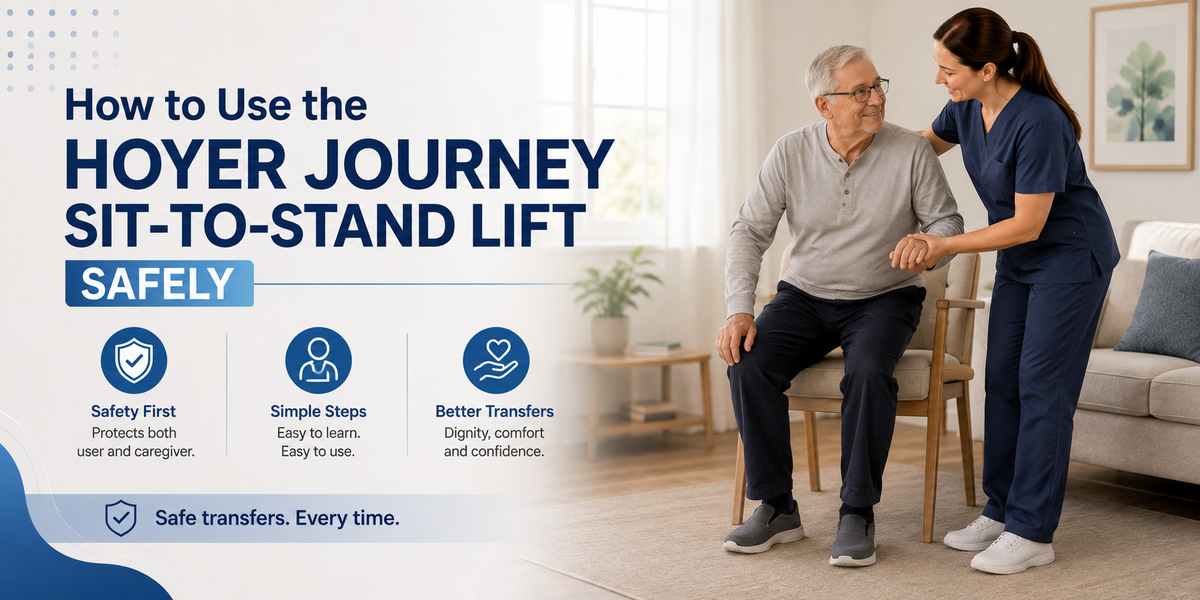
The Hoyer Journey is an active sit-to-stand lift designed for patients who are in a sitting position, have some weight-bearing ability, and require assistance to stand. Joerns recommends that each transfer be properly assessed and performed by a trained, competent caregiver.
Preparation Checklist
- Ensure the battery is adequately charged before use.
- Clear the transfer path and make sure there is enough room to maneuver the lift.
- Inspect the Journey, sling attachment points, and sling before use.
- Confirm that the patient has an appropriate degree of weight-bearing ability for a sit-to-stand transfer.
- Select either a Hoyer Standing Sling or Hoyer Transport Sling that is appropriate for the patient and transfer.
- Adjust the kneepad so it supports the patient just below the kneecap, as appropriate for the individual.
- Adjust the Journey’s sling attachment cradle to a position appropriate for the patient’s height and seating position.
- Plan the transfer and explain the process to the patient before beginning.
Standard Sit-to-Stand Sequence
- Position the Journey so the patient’s feet are correctly placed on the foot tray and the knees rest against the kneepad.
- Keep the rear castors free and the brakes released while lifting.
- Fit the appropriate Hoyer Standing or Transport Sling according to the sling instructions.
- Attach the sling loops securely to the Journey sling attachment hooks.
- Confirm visually that all sling loops are securely attached before lifting.
- The patient may place their hands on the Journey handgrips, sling straps, or trailing loops if appropriate and comfortable, while avoiding pinch points.
- Raise the patient smoothly using the hand control.
- Move the Journey carefully using the designated handle and foot push pad.
- Lower the patient in a controlled manner onto the destination surface.
- Once the patient is safely supported, detach and remove the sling as appropriate.
Journey Caster & Brake Safety
The Hoyer Journey has two braked rear castors that may be used for parking. During ordinary lifting, Joerns instructs that the castors should remain free and unbraked so the lift can move toward its natural center of gravity.
Joerns separately instructs caregivers to lock the wheels when lifting from the floor. Always follow the current Hoyer Journey user manual for the specific transfer being performed.
Patient Suitability
The Hoyer Journey is intended for patients in the sitting position who have some weight-bearing ability but need assistance to stand. It is not a full-body passive lift for patients who cannot participate in the transfer.
Joerns recommends a patient-specific risk assessment before each use to determine whether the Journey and the selected sling are appropriate for the patient and transfer.
Compatible Hoyer Journey Slings
Joerns identifies two primary sling types for use with the Hoyer Journey:
- Standing transfer support → Hoyer Standing Disposable Sling
- Standing and short transport transfers → Hoyer Deluxe Transport Sling
These are specialized sit-to-stand slings and are not general-purpose full-body slings. Sling selection should be based on the patient’s weight-bearing ability, body size, trunk control, mobility, transfer requirements, and clinical assessment.
Always confirm the sling size, safe working load, attachment method, and condition before use.
Kneepad Adjustment
The Journey has an adjustable kneepad with approximately 10.2 inches of travel. Joerns recommends positioning the kneepad just below the kneecap and adjusting it to suit the individual patient.
Make sure the kneepad adjustment mechanism is securely locked in position before beginning the transfer.
Removable Foot Tray & Gait Training
The Journey includes a removable foot tray. For normal sit-to-stand transfers, the patient’s feet are positioned on the tray while the knees rest against the kneepad.
Joerns allows the Journey to be used as a walking aid with the foot tray removed, but only after a careful risk assessment confirms that gait training is appropriate for the patient.
Gait training should not be treated as a routine extension of a standard sit-to-stand transfer. Follow the current Journey manual and the patient’s care plan.
341 lb Safe Working Load
The Hoyer Journey has a safe working load of 341 lb (155 kg). Never exceed the safe working load of the lift or the sling being used.
Moving the Journey
Joerns instructs caregivers to maneuver the Journey using the designated handle. A foot push pad is also provided to assist with initiating movement.
A loaded lift should be moved only at a slow walking pace and should not be pushed over uneven ground, rough surfaces, or floor obstructions.
Related Hoyer Patient Lifts
- Higher-capacity powered sit-to-stand option → Hoyer Elevate
- Manual active-transfer option → Hoyer Up
- Portable full-body passive lift → Hoyer Advance-E 340
- Higher-capacity full-body passive lift → Hoyer Presence Pro 500
Need Help With Your Hoyer Journey?
Call 877-33-HOYER for help identifying compatible Hoyer Journey slings, replacement parts, accessories, or the correct Joerns manufacturer resources for your Hoyer Journey.


