

How one man’s determination created a device that transformed safe patient handling
For decades, the name “Hoyer” has been almost synonymous with patient lifts. Caregivers, clinicians, and families often use the term generically—the way people once said “Kleenex” for any tissue. Behind that everyday word is a powerful story of personal adversity, practical engineering, and lasting impact on healthcare.
This article expands on the history of Ted Hoyer and the invention of the patient lift, placing it in the broader context of safe patient handling so readers understand not only what happened, but why it still matters today.
The Problem Before the Hoyer Lift
Before mechanical patient lifts became common, transferring someone with limited or no mobility usually meant manual lifting. Two or more caregivers would physically hoist a person from bed to wheelchair, wheelchair to toilet, or wheelchair into a car. The risks were high on both sides:
- Caregivers frequently suffered back, shoulder, and neck injuries from repetitive heavy lifting.
- Patients could experience pain, skin shear, fear, or loss of dignity during awkward transfers.
- In institutional settings, high injury rates among nursing staff contributed to turnover and higher costs.
Ted Hoyer lived this reality every day after a life-changing accident. His solution did more than solve a personal problem—it helped shift the industry toward safer, more mechanical methods of patient handling.
Ted Hoyer’s Accident and Determination
In September 1936, 16-year-old Theodore Robert “Ted” Hoyer was a student-athlete. A minor injury kept him from playing in an away game, so he accepted a ride from a friend to cheer on his team. The car crashed. Ted suffered a severed spinal cord and became a quadriplegic.
Despite the profound change in his physical abilities, Ted remained active and entrepreneurial. He ran a magazine sales and subscription business and wrote for various publications. He needed a practical way to move between bed, wheelchair, and car without constantly relying on others to lift him. That personal need drove the invention.
Building the First Lift
In 1949, Ted worked with his cousin, Victor Hildemann, in Ted’s double garage in Oshkosh, Wisconsin. Together they developed what became the first powered Hoyer patient lift. The device used a hydraulic mechanism to raise and lower a person smoothly in a sling, supported by a stable wheeled base.
A contemporary description in the Oshkosh Northwestern captured its purpose clearly:
“The device, which gently and easily lifts the handicapped person from bed and lowers him into a wheelchair, is so versatile that it is also used to help the patient in and out of automobiles.”
The first commercial unit after the prototype was sold in March 1950 to John Allen Adams. According to the same newspaper, Adams was still using that lift without major issues six years later, in 1956—an early testament to the design’s durability.
From Garage Prototype to Formal Company
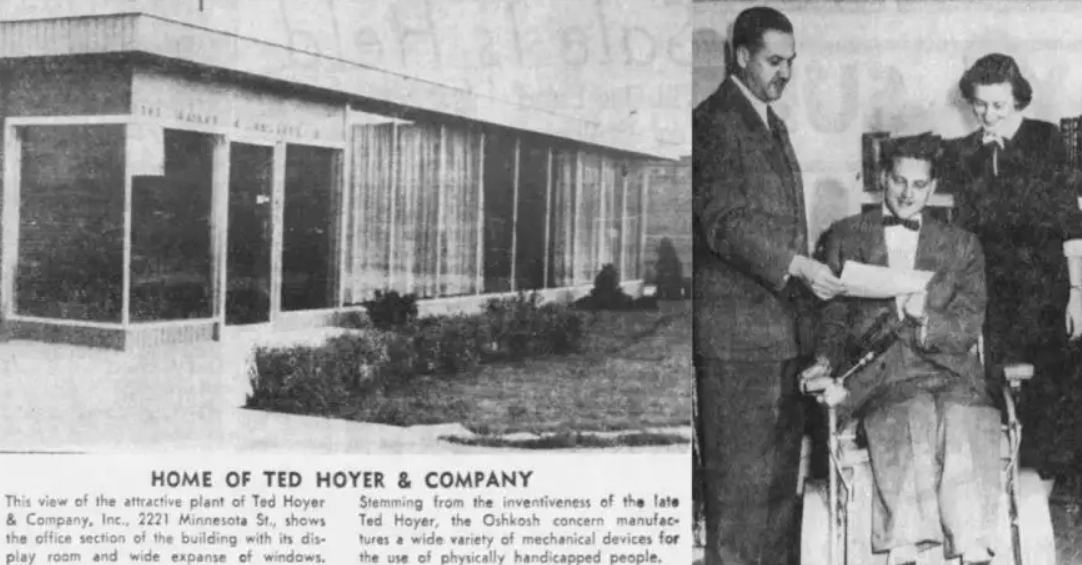
Ted Hoyer & Company was established in September 1951. By 1953 the company occupied a dedicated factory at 2221 Minnesota Street in Oshkosh. At the time of the factory opening it had only three employees. Ted and his wife (they married in 1952) handled the office side of the business while production expanded from basic patient lifts to specialized versions for cars, baths, and pools.
The design continued to evolve. Key early patents include:
- U.S. Patent 2,821,406 (filed 1954, issued 1958) – “Adjustable base invalid lift,” listing Theodore R. Hoyer and Victor R. Hildemann as inventors. This covered the adjustable U-shaped base that remains a foundational concept in many floor lifts.
- Related work on vehicle-mounted and later mobile designs, including patents assigned to Ted Hoyer & Company.
These patents formalized the engineering principles that made the lifts stable, adjustable, and practical for everyday use.
Recognition and Early Legacy
Ted Hoyer’s work earned formal recognition. In 1952 he received a citation for outstanding service from the President’s Committee for Employment of the Physically Handicapped, acknowledging his efforts to promote equal opportunity for people with disabilities in Wisconsin. Shortly before his death, Ted Hoyer & Company received the first honorary membership in the Associated Industries of Oshkosh. Local business leaders praised the company as an example of free enterprise driven by courage and initiative.
Ted Hoyer died in March 1954, less than a year after the factory opened. Production continued under his wife and cousin. Over the following decades the brand grew, was later acquired (including by Sunrise Medical in 1992), and is today owned and manufactured by Joerns Healthcare, LLC. Genuine Hoyer® lifts remain a core product line focused on safe patient handling.
Why the Invention Still Matters Educationally
Ted Hoyer’s original goals—greater independence for the person being moved and reduced physical strain on caregivers—remain the foundation of modern safe patient handling programs. Contemporary guidelines from healthcare organizations and regulators emphasize mechanical lifts precisely because manual lifting carries measurable injury risks.
Key educational principles that trace back to the early Hoyer design include:
- Stability through base geometry — An adjustable, wide base improves balance during the lift.
- Controlled, powered movement — Hydraulic (and later electric) systems allow smooth raising and lowering instead of sudden or uneven manual effort.
- Sling interface — Proper sling selection and attachment distribute weight and protect skin integrity.
- Versatility across environments — Early models already addressed bed, wheelchair, and vehicle transfers; modern Hoyer lifts expand this to home care, acute care, long-term care, and bariatric needs.
Today’s Joerns Hoyer lifts build on these principles with lighter materials, improved ergonomics, battery power, and a wide range of specialized slings. Among them, the Hoyer Advance-E 340 portable patient lift has become one of the most popular models sold today. Its compact, foldable design, 340 lb capacity, and ease of use for home and facility settings continue the same practical philosophy Ted pioneered: safe, controlled transfers that protect both the patient and the caregiver.
The Name That Became a Category
Because the original design proved so effective and widely adopted, “Hoyer lift” entered common usage much like other brand names that became genericized. While many manufacturers produce patient lifts, authentic Hoyer® products are those manufactured by Joerns Healthcare. As an authorized dealer, MyHoyerLift.com focuses exclusively on genuine Joerns Hoyer equipment so customers receive the design continuity, support, and quality associated with the brand’s long history.
Continuing the Legacy
Ted Hoyer did not set out to create an industry standard. He set out to regain independence and reduce the physical burden on the people helping him. The result was a practical engineering solution that has helped millions of patients and caregivers over more than seven decades.
When you choose a genuine Hoyer lift today, you are using equipment that still reflects the priorities established in Oshkosh in the late 1940s and early 1950s: controlled movement, mechanical advantage, and respect for both the person being transferred and the person performing the transfer.
If you are evaluating a patient lift for home care or a clinical setting, understanding this history helps explain why certain design features—adjustable bases, reliable hydraulic or electric actuators, and purpose-built slings—remain so important.
Explore genuine Joerns Hoyer® patient lifts at MyHoyerLift.com. Our team can help you match the right model and sling configuration to your specific transfer needs.


